
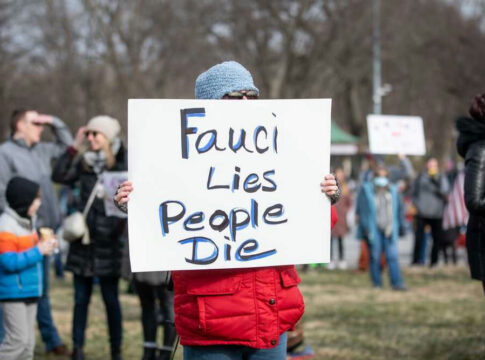
A single Senate witness just challenged the story America was told about COVID’s origin—and he did it with the vocabulary of intelligence work, not cable news.
A hearing timed to the statute clock, not the news cycle
Sen. Rand Paul’s committee didn’t stumble into this moment; it scheduled it. The hearing occurred days after a key legal window closed, the statute of limitations tied to whether Fauci could be charged for allegedly lying to Congress about gain-of-function research. That timing shaped the entire atmosphere: less “should we prosecute” and more “who controlled the narrative.” Paul framed it as a long-running, multi-agency cover-up demanding receipts.
James Erdman III arrived with a résumé that mattered to skeptics: career CIA operations officer, detailed to ODNI on joint duty from March 2025 to April 2026, and positioned to describe how conclusions get massaged before the public ever sees them. His core claim wasn’t that analysts lacked data; it was that leadership and process choices steered analysts toward a preferred outcome. That difference—absence of evidence versus management of evidence—drives why the testimony hit so hard.
What Erdman said the intelligence process looked like from the inside
Erdman’s testimony centered on mechanics: who gets invited into “expert” circles, what conflicts are tolerated, and how language gets calibrated in official products. He pointed to internal group dynamics and asserted that certain advisory pathways were packed with individuals whose institutions had financial or professional entanglements with NIH-linked research. He described the result as a systematic downplaying of lab-origin signals, not necessarily a single memo ordering analysts to comply.
The most combustible part was the directness. Erdman didn’t merely criticize bureaucracy; he alleged Fauci’s role in making the cover-up “intentional,” arguing that curated expert conversations and strategic relationships shaped the intelligence community’s posture. That is a serious accusation, and readers should hold two thoughts at once: testimony is not a conviction, and testimony from a positioned insider can still expose how incentives and reputations steer outcomes even without a smoking-gun directive.
The Fauci question: gain-of-function definitions and the power to rename a problem
Fauci’s defenders have leaned for years on a familiar line: the funded work didn’t meet the definition of gain-of-function as they understood it. Erdman’s side of the argument targets the definitional escape hatch itself—how policy and terminology can get reworked so yesterday’s risky experiment becomes today’s “not technically that.” The hearing also revived the practical question Americans understand instinctively: if you have to redefine a term repeatedly to avoid accountability, the public hears evasion.
The testimony also rode on a larger trail of controversy: NIH funding that reached Wuhan-associated research through EcoHealth Alliance, the shifting U.S. posture on gain-of-function oversight, and the political aftershocks of pandemic-era mandates. Those threads don’t prove a lab leak, but they do justify scrutiny. Conservative common sense lands here: when government money, government prestige, and government messaging align too neatly, transparency becomes a duty, not a partisan hobby.
Event 201 and the expert class problem Americans can actually see
Erdman’s narrative folded in Event 201 and other tabletop exercises as markers of a tight ecosystem—agencies, academics, and public-health elites who circulate through the same conferences and panels. The point isn’t that simulations “caused” COVID; that leap doesn’t follow from the known facts. The point is cultural: when the same small network war-games a scenario, funds related work, advises government, and then polices dissent, the incentives to protect reputations become overwhelming.
That ecosystem critique resonates with older readers because it mirrors other institutional failures: Iraq WMD certainty, financial-crisis blind spots, and the bureaucratic instinct to protect the brand before telling the truth. Erdman’s testimony essentially asked the Senate to treat COVID origins not as a scientific parlor fight but as an institutional integrity test. Once the public suspects integrity is negotiable, every future emergency response gets harder.
What the hearing can change—and what it probably can’t
The hearing can spur subpoenas, compel documents, and pressure agencies to explain analytic tradecraft, conflicts, and edits. It can also energize reforms on whistleblower protections inside the intelligence community, where “need to know” can become “need to shut up.” What it likely can’t do is deliver immediate legal closure on Fauci-related claims now that the referenced limitations window has passed, absent new conduct or different charge theories.
The larger consequence is political and cultural: Americans recalibrating their trust. Paul’s critics call this a recycling of conspiracies; Paul’s supporters see overdue sunlight. The most responsible takeaway sits between those impulses. Erdman made allegations that require corroboration, but the structure of his critique—conflicts, curated expertise, selective certainty—matches patterns citizens have watched in other bureaucracies. The next step is documents and cross-examination, not slogans.
Trust comes back the slow way: disclose the underlying analyses, show edits and dissent, publish who advised whom, and stop treating ordinary questions as a threat. That’s the conservative value at stake here—accountability in institutions that spend taxpayer dollars and claim authority over public behavior. If leaders want Americans to comply in the next crisis, they’ll need to prove they told the truth in the last one, even when it was inconvenient.
Sources:
Rand Paul brings CIA whistleblower to Senate hearing alleging deep state COVID-19 conspiracy
Sen. Rand Paul announces COVID ‘whistleblower’ testimony in committee this week
Whistleblower Testimony on the COVID Coverup