
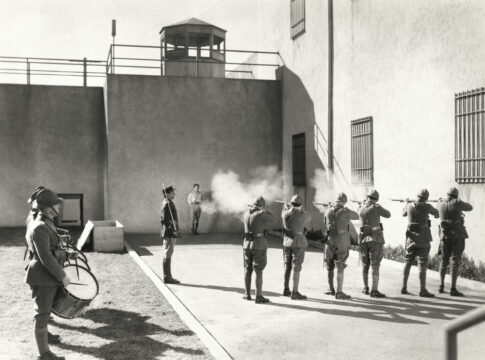
Idaho has now made the firing squad its primary way to carry out the death penalty, putting hard punishment and government secrecy on a collision course.
Story Snapshot
- Idaho law now makes the firing squad the state’s main execution method starting July 1, 2026.
- Specially trained law enforcement volunteers must meet strict shooting standards and follow a detailed 36-page protocol.
- Supporters say the firing squad is faster, more certain, and cheaper than lethal injection.
- Critics warn about graphic deaths, past failures in other states, and new secrecy rules that block public review.
Idaho Moves Firing Squad to the Front Line of Capital Punishment
On March 12, 2025, Idaho Governor Brad Little signed House Bill 37, making the firing squad the state’s primary execution method, with the law taking effect July 1, 2026. Lawmakers backed the bill by wide margins, 58–11 in the House and 28–7 in the Senate, showing strong political support for tougher punishment. Under the law, lethal injection is pushed to a backup role and used only if the firing squad cannot be certified as available for a given execution. Idaho is now the only state that treats the firing squad as its main method of execution, even though four other states also allow it in some form.
The Idaho Department of Correction was ordered to create detailed procedures for these executions and release an official protocol. That protocol runs 36 pages and spells out step-by-step rules, from how the prisoner is prepared to how the shooters are chosen and tested. The department also had to retrofit an existing execution chamber, a project reported at roughly $950,000 to more than $1 million in construction and equipment costs. Supporters argue that, after the upfront price tag, ammunition and firearms will be cheaper and easier to obtain than lethal injection drugs, which have become harder to source.
How Idaho’s Firing Squad System Is Designed to Work
Idaho’s firing squad will be made up of volunteer law enforcement officers who meet strict standards set by the department. Each volunteer must be an Idaho peace officer certified through the state’s training program for at least three years, with no disciplinary problems in the past year and no blood or legal ties to the victim or the prisoner. Before they can serve, volunteers must pass a firearm proficiency test, proving they can hit a target the same size, shape, height, and distance used in an execution, from about seven yards away. The test is failed if they cannot strike that target with one round from each weapon they will use.
The protocol also focuses on how the condemned person is handled on the day of execution. According to the document, the prisoner will be offered a mild sedative the night before and again within four hours of the scheduled time, meant to lessen anxiety before the event. Staff will strap the person into a special execution chair facing the firing squad, with a clear target fixed over the heart to guide the shooters. Representative Bruce Skaug, a key sponsor of the bill, has said this setup is “humane because it is sudden, it is quick, and it is certain,” arguing that a well-aimed volley to the heart ends life faster than many failed lethal injections.
Supporters Praise Tough Justice, Critics Warn About Secrecy and Risk
Backers in Idaho say this shift reflects strong public support for the death penalty and frustration with years of delayed executions due to drug shortages and lawsuits. They argue that a shooting team made up of seasoned police officers, all tested for perfect accuracy at close range, offers a more reliable end than complex chemical protocols that can go wrong. Many conservative voters also see the firing squad as a firm response to the worst crimes, especially after Idaho passed another law using it as a penalty for aggravated sexual abuse of children under age twelve.
Today the State of Idaho makes the firing squad its primary form of execution.
It joins 4 other states in utilizing firing squad. pic.twitter.com/uAoEBU3azm
— Bradley Warren (@bradmwarren) July 2, 2026
Opponents focus on two major concerns: how firing squads look and how this new law shields information from view. The Death Penalty Information Center points to cases in South Carolina where firing squad bullets missed the heart and a prisoner bled to death, challenging claims of a quick, painless death. They also note that firing squads fell out of favor in the past precisely because the method is so graphic and disturbing to watch. On top of that, Idaho’s broader secrecy rules now hide many details about execution team members and procedures from the public and even from most court oversight, raising questions about accountability when the government uses deadly force in citizens’ names.
Sources:
pjmedia.com, idahostatesman.com, police1.com, youtube.com, deathpenaltyinfo.org, forms-idoc.idaho.gov, facebook.com, davisvanguard.org, corrections1.com, reddit.com