
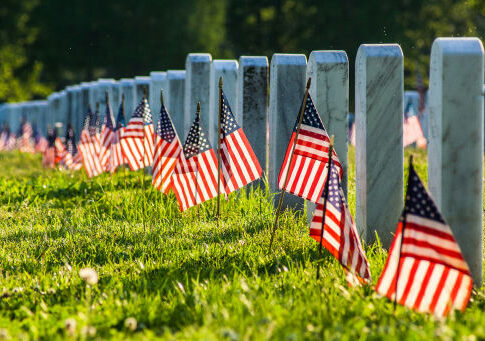
The quiet white headstone of Specialist Richard Leroy McKinley in Section 31 at Arlington National Cemetery hides what may be the strangest battlefield of the Cold War: a radioactive grave created by America’s first fatal nuclear reactor accident.[2]
Story Snapshot
- Only one grave in Arlington National Cemetery is officially recorded as radioactive, and it belongs to Army Specialist Richard Leroy McKinley.[2][5]
- McKinley died in 1961 after a catastrophic reactor incident at a remote Army test site in Idaho, the first fatal nuclear accident on American soil.[1][2][4]
- His remains were so contaminated they required a double lead-lined casket, concrete, a metal vault, and a permanent “do not move” order on the grave.[1][2][3]
- The story blends Cold War ambition, government caution, and one family’s sacrifice into a lesson about risk, restraint, and national memory.[1][2][4]
The young specialist who became a Cold War cautionary tale
Specialist Four Richard Leroy McKinley did not set out to be a symbol of nuclear risk; he was a working soldier and nuclear power plant mechanic operator in the United States Army Engineer Corps.[2][4] Born in Indiana in 1933 and raised in Ohio, he served in the Korean War and later trained for the Army’s nuclear power program, a prestigious technical track in an era when nuclear energy promised cheap power and military advantage.[2][4][5] His skills placed him at the National Reactor Testing Station in Idaho, far from traditional front lines but squarely inside the Cold War’s technological race.[2][4]
On January 3, 1961, McKinley reported for duty at Stationary Low-Power Reactor One, a small experimental reactor designed to power remote radar or missile sites.[1][2][3] Inside the reactor building with him were Army Specialist John Arthur Byrnes and Navy Seabee Richard Carlton Legg, fellow operators on what should have been routine maintenance.[1][2] Minutes later, an improperly withdrawn central control rod triggered a near-instant supercritical reaction, a steam explosion, and the United States’ first fatal nuclear reactor accident.[1][2][3][4] Byrnes and Legg died at the scene; McKinley briefly survived but succumbed to injuries soon after reaching an ambulance.[1][2]
Check this out. A radioactive grave site. pic.twitter.com/1Atfu5BUhz
— Steve 🇺🇸 (@SteveLovesAmmo) March 28, 2026
Why one body required a fortress of concrete and lead
Recovery teams entering the wrecked SL-1 building found lethal radiation levels and three badly damaged men, each contaminated by radioactive material from the ruptured core.[2][4] Arlington’s own educational material reports that McKinley’s recovered remains “were, and still are, radioactive,” a blunt acknowledgment that even in death his body carried long-life isotopes from the accident.[2][4] Radiation experts concluded his remains could not be handled or buried like a normal casualty without long-term safeguards that would endure decades beyond the Cold War itself.[1][2][4]
Here the story collides directly with family grief and federal caution. McKinley’s wife requested that he be buried at Arlington National Cemetery, citing his Korean War service and his status as a Cold War casualty.[2] Cemetery and Atomic Energy Commission officials agreed, but only under extraordinary conditions.[1][2][3] On January 25, 1961, just twenty-two days after the accident, his family attended an eight-minute funeral held at a distance of twenty feet, a separation imposed for radiological safety rather than ceremony.[1][2][4] After Taps, workers lowered a double lead-lined casket encased in concrete, surrounded it with a metal vault in a ten-foot-deep grave, and then poured an extra foot of concrete over the top.[1][2][3][4] The goal was simple and sobering: his body would never again pose a risk to the living.
The only radioactive grave in America’s most sacred military cemetery
The finished burial plot looks, at first glance, ordinary. Arlington describes the white marble headstone of Specialist Four Richard Leroy McKinley as visually similar to others in Section 31, yet identifies it explicitly as “Arlington National Cemetery’s only radioactive grave.”[2] That designation is not folklore; it is baked into his cemetery file, which carries a stark warning from the era of slide rules and civil defense drills.[1][2][3] The file notes: “Victim of nuclear accident. Body is contaminated with long-life radio-active isotopes. Under no circumstance will the body be removed from this location without prior approval of the Atomic Energy Commission in consultation with this headquarters.”[1][2][3]
Modern visitors can walk directly up to the stone with zero danger, because the shielding and distance from the remains reduce exposure to background levels.[1][2][5] The risk sits beneath the soil, locked behind lead and concrete, a permanent engineering answer to a permanent contamination problem. Some writers have labeled it “the most dangerous gravesite in the world,” playing on the drama of radiation and mystery.[1][3] Yet the facts, viewed through common-sense conservative values, tell a different story: a government that, for once, did not cut corners; technicians who insisted on overbuilding the protection; and a quiet, unpublicized commitment never to move the remains without top-level nuclear oversight.[1][2][3]
What this grave says about Cold War ambition and restraint
The SL-1 accident and McKinley’s burial capture a contradiction at the heart of mid-century America. Federal planners pushed nuclear technology hard, selling it as both a military edge and a civilian miracle, while the true costs of failure fell on a handful of young, mostly working-class servicemen far from any battlefield.[1][2][4] At the same time, the response to McKinley’s remains shows a level of seriousness that puts much of today’s bureaucratic carelessness to shame: technical experts drove decisions, and the written orders prioritized safety across generations.[1][2][3]
For visitors over forty who remember duck-and-cover drills or the glow of nuclear power debates on the evening news, McKinley’s grave offers a physical anchor in that history. The stone says little, but the file behind it tells a full-spectrum story: a specialist who trusted his chain of command, a family who chose Arlington for honor, a nation willing to admit that some technologies carry lasting consequences.[1][2][4][5] In an era of short attention spans and shallow headlines, that quiet radioactive plot in Section 31 still whispers a long, serious question: how far should a country go in pursuit of power before the risks to its own people outweigh the promises?
Sources:
[1] Web – America
[2] Web – [PDF] COLD WAR – Education – Arlington National Cemetery
[3] Web – This E-4’s grave is the most dangerous gravesite in the world
[4] Web – The most dangerous gravesite in the US resides in Arlington Cemetery
[5] Web – SP4 Richard Leroy McKinley (1933-1961) – Find a Grave Memorial