
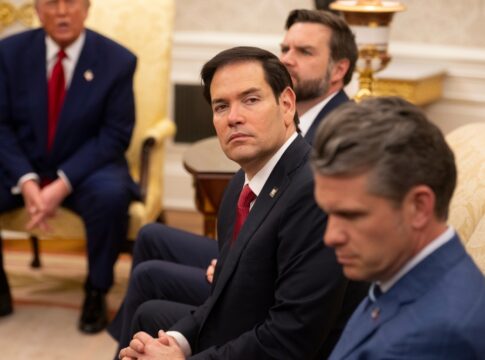
Senior Trump officials quietly turned a sweeping Europe troop cut into a slow, controlled review, after Marco Rubio reportedly blocked Defense Secretary Pete Hegseth’s plan for rapid drawdowns.
Story Snapshot
- Hegseth signaled major changes to U.S. forces in Europe but formally launched a six‑month review instead of full, immediate cuts.
- Reports say Rubio and other senior officials rejected Hegseth’s plan for deeper troop reductions before it reached NATO.
- About 5,000 U.S. troops are already slated to leave Europe, with more drawdowns expected as allies boost their own defenses.
- New limits from Congress and NATO planning may cap how fast and how far America can pull back forces from Europe.
Hegseth’s Tough Message To NATO And The Europe Troop Review
War Secretary Pete Hegseth used a June 18 meeting with NATO defense ministers in Brussels to send a blunt message: Europe must carry more of its own weight. He announced a Pentagon review of U.S. troops and bases across Europe that could last up to six months and said future deployments would depend on allies meeting defense spending targets. Hegseth also noted that U.S. troop levels had already been returned to pre‑2022 levels and that 5,000 forces had been reduced earlier in the year, signaling that the pullback had begun.
Major outlets like Reuters and The Washington Post framed Hegseth’s move as a “review” rather than a sudden, large withdrawal, stressing the study period and consultations with Congress. That careful wording suggested Washington wanted to pressure European capitals without shocking NATO with an overnight exit. At the same time, CNN reported that Hegseth had already canceled two planned U.S. military deployments to Europe and ordered some personnel removed, showing that at least limited cuts were happening in real time. This mix of tough talk and phased action fits a familiar Trump pattern of leverage through uncertainty.
Rubio’s Reported Role In Blocking Deeper Immediate Cuts
Mediaite and Kurdistan 24, citing a Wall Street Journal exclusive, report that Secretary of State Marco Rubio and other senior officials explicitly blocked Hegseth from rolling out a more aggressive troop drawdown plan before it could be presented at NATO. According to those accounts, the proposal for larger immediate cuts was “rejected” or “nixed” after Rubio and colleagues reviewed it, and the White House instead backed the six‑month review approach. Pentagon spokesman Sean Parnell is quoted saying Hegseth ensured his message aligned with President Trump’s objectives and did not want to limit the president’s decision space, reinforcing that this slower path was a deliberate choice.
Rubio has publicly said that reducing U.S. troops in Europe is an ongoing process carried out in coordination with allies, not a surprise retreat. NATO’s Supreme Allied Commander Europe, General Alexus Grynkewich, has echoed that idea, explaining that 5,000 troops will be withdrawn and that more redeployments are expected over several years as European countries strengthen their own forces. For conservative readers, this means the administration is still moving to shrink America’s burden in Europe, but is trying to do so in a way that does not hand propaganda victories to Russia or panic nervous European governments.
What Has Already Changed On The Ground In Europe
Despite the focus on “review” language, several concrete steps are already in motion. NATO’s top commander has confirmed that a total of 5,000 U.S. troops will leave Europe, largely through the redeployment of an armored brigade combat team and the cancellation of a long‑range fires battalion deployment. Reports from Deutsche Welle and Defense News note that the Pentagon has said 5,000 troops will be withdrawn from Germany, and that American officials are working through which permanent bases and families may be affected. Separately, Euronews highlighted Hegseth’s earlier removal of about 800 troops from an infantry brigade in Romania, which will not be replaced, feeding wider European fears about a long‑term U.S. pivot away from the continent.
NATO Secretary General Mark Rutte has tried to calm those fears, stressing that the planned U.S. troop reductions are structured and will not weaken core defense plans. He has said many of the troops involved are rotational crisis forces, not the backbone of Europe’s day‑to‑day security. At the same time, he has acknowledged that Washington will lower the number of forces it stands ready to contribute in a crisis as European members finally increase defense spending. For American conservatives, this marks a long‑overdue shift: Europe is being told to fund and field its own armies instead of living off U.S. taxpayers and U.S. troops forever.
Congress, Constraints, And What Comes Next For Trump’s Europe Strategy
Inside Washington, lawmakers are moving to shape how far the administration can go. Politico has described Pentagon officials as “stunned” by some of Hegseth’s surprise decisions on European troop moves and noted internal documents suggesting the study does not call for a massive withdrawal, hinting at pushback from the defense bureaucracy. Members of Congress are also considering language that would bar cutting troop numbers in Europe below a set floor, reportedly around 76,000, without a formal military risk assessment and certification. That kind of restriction could slow deeper reductions even if Trump, Rubio, and Hegseth decide Europe should stand more on its own feet.
Senior Trump officials, including Secretary of State Marco Rubio, blocked Defense Secretary Pete Hegseth from announcing major U.S. troop cuts in Europe at last month's NATO meeting. Hegseth instead announced a six-month review of U.S. force levels in Europe.
— Open Source Intel (@Osint613) July 3, 2026
Opinion writers at Defense News warn that troop cuts risk giving away leverage in transatlantic trade and investment without clear returns, and they stress that naval and air units are now on the list of forces the U.S. will no longer make available for NATO war plans. For constitutional conservatives, this debate boils down to a core question: will America continue to defend Europe at great cost while our own border is under strain, our debt climbs, and woke elites demand more foreign crusades, or will we finally insist that wealthy European countries pay for their own defense and respect U.S. decision‑making? The Trump team’s current path — real but measured withdrawals, a tough review, and firm conditions on allied spending — suggests the president is trying to turn decades of globalist promises into concrete change without undermining U.S. strength.
Sources:
mediaite.com, legion.org, reuters.com, washingtonpost.com, facebook.com, aa.com.tr, openthemagazine.com, youtube.com, democrats-foreignaffairs.house.gov, militarytimes.com, euronews.com